Medical Technology
How Are Advanced Laser Technologies Transforming Medicine and Health Care?
What Are Medical Lasers?
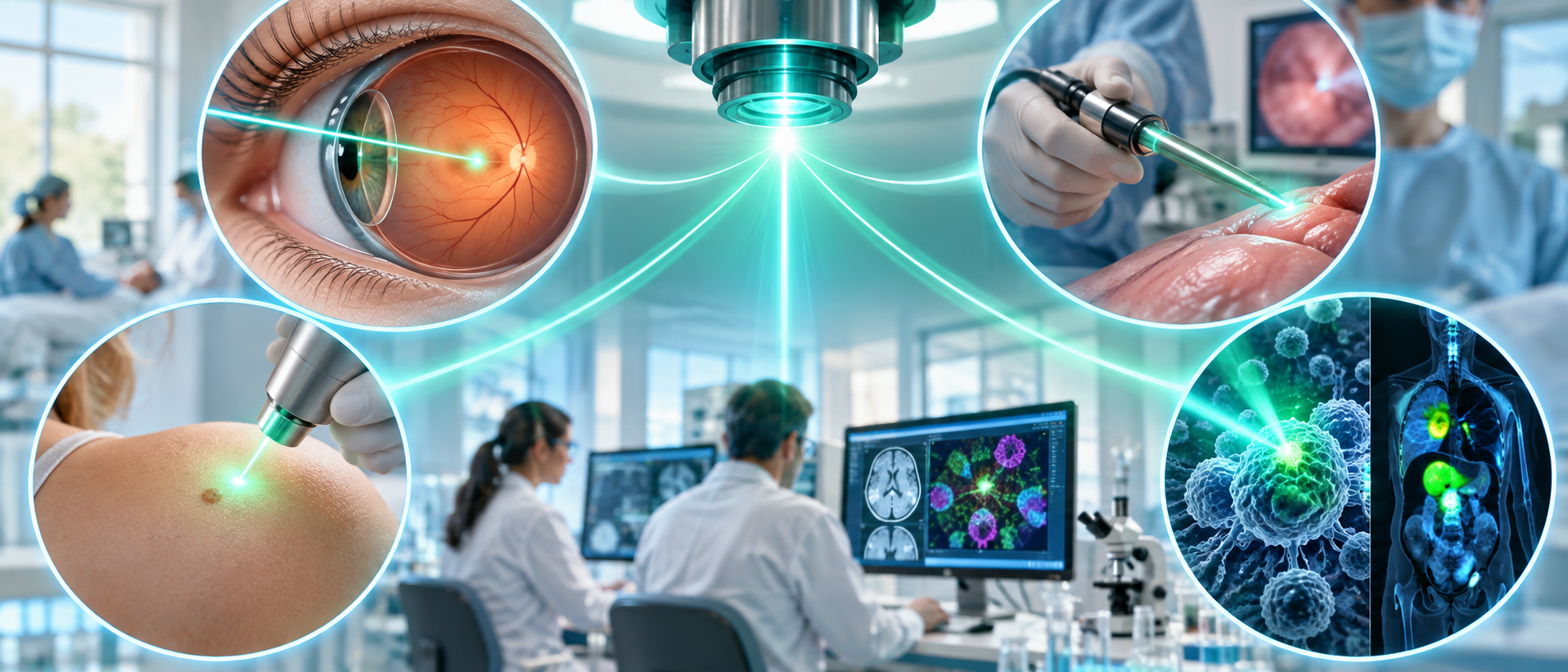
Medical lasers produce concentrated light with carefully selected wavelengths, pulse durations and energy levels. Because different tissues absorb light differently, clinicians can use lasers to cut, seal, reshape, remove or image targeted tissue with high precision. Their usefulness depends on choosing the right laser and controlling how its light interacts with the body.
Where Are Lasers Creating Helpful Change?
Eye care
Excimer, femtosecond and retinal lasers support vision correction, cataract procedures and treatment of selected retinal and glaucoma conditions.
Minimally invasive surgery
Laser energy delivered through thin fibers or endoscopes can cut, seal blood vessels or remove abnormal tissue in confined areas.
Dermatology and dentistry
Different wavelengths are used for skin resurfacing, vascular or pigment treatments, hair removal and selected dental procedures involving soft or hard tissue.
Cancer treatment
Lasers may remove or destroy tumors, relieve blockages and activate medicines that are sensitive to light during photodynamic therapy.
Imaging and emerging therapies
Optical imaging, drug delivery assisted by lasers, treatment guided by imaging and photobiomodulation are being studied for earlier detection, greater precision and improved healing.
What Is the Research Scope for RQL Students?
Students focused on premedical studies, health and medicine can choose one laser application and study the science behind it, its clinical benefits and its limitations. An RQL project based on literature can compare wavelengths, tissue interaction, precision, safety, recovery, cost and access. Students may also examine how newer approaches could improve patient care.
Emerging research points
- Ultrafast lasers
- Systems delivered through optical fibers
- Drug delivery assisted by lasers
- Optical imaging
- Treatment guided by AI
RQL Research Question
Which emerging medical laser application offers the greatest potential benefit, and what challenges must be overcome to make it safer, more precise and more accessible?